Scientists have placed a fly's digital brain into the "Matrix." Now it flies through an AI-generated world!
Digital model of a Drosophila brain, flight control, Odyssey virtual worlds, merging biology and AI, neural networks and their applications

A digital model of the Drosophila fruit fly brain has been connected to Odyssey 3, a generative system capable of creating virtual worlds. In the published video, the fly moves over a harbor, flying past boats and buildings. The surrounding environment exists solely within the artificial intelligence.
The developers claim that the insect's brain model controls its direction of movement. If this connection truly works as claimed, the experiment demonstrates the possibility of merging biological neural models with virtual worlds that form dynamically during interaction.
How a fly's brain ended up inside an artificial world
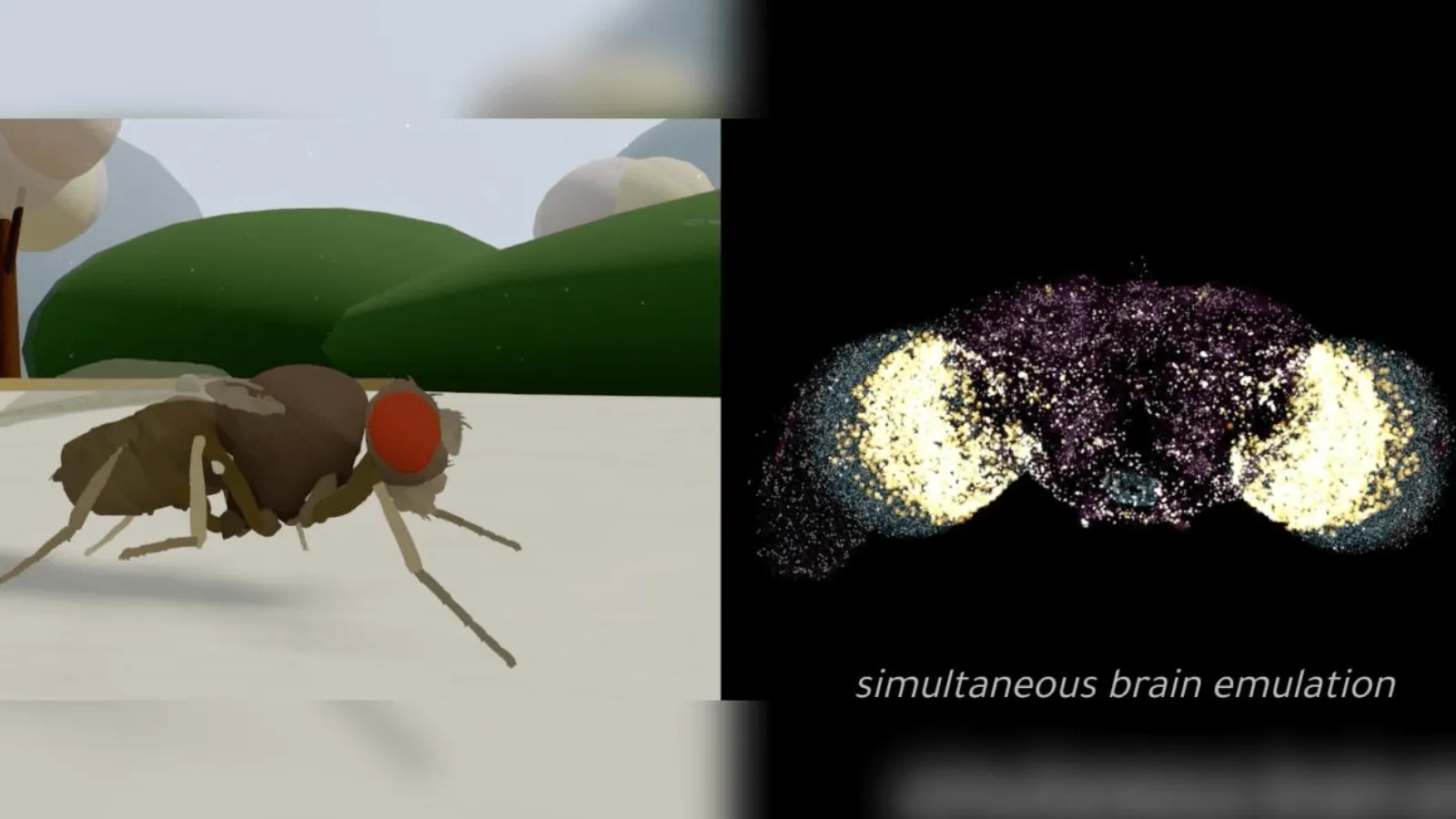
On October 17, 2026, Odyssey released a roughly 30-second video showing a virtual Drosophila flying through a generated environment. Most of the screen features a first-person view of the moving object, while an animated model of the insect is displayed in the corner.
The idea is to combine two technologies. The first allows for the reproduction of neural network functions based on the anatomy of a real brain. The second creates a virtual space that can change depending on the participant's actions.
In a traditional video game, the environment is usually pre-designed by artists and programmers. A generative world model is capable of forming new scenes as you move. Theoretically, this allows digital nervous systems to be placed in a vast array of different situations without the need to manually create each one.
However, Odyssey has not yet revealed how the signals from the virtual brain are converted into flight commands, or exactly which environmental data is fed back into the neural model.
Why did researchers start specifically with a fly?
Drosophila has become one of the most thoroughly studied organisms in neurobiology.
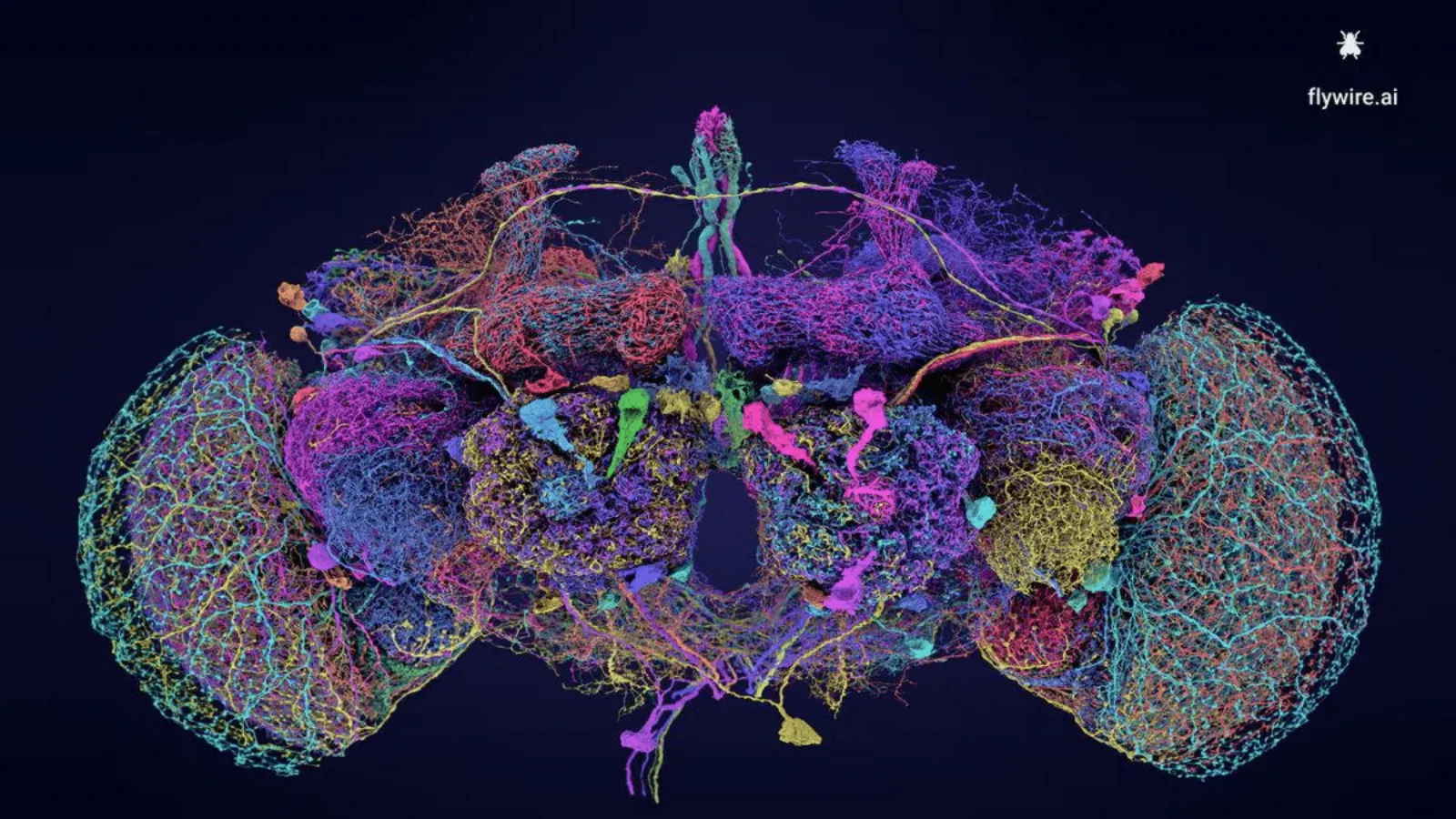
In 2024, the international FlyWire team presented a detailed map of the adult fruit fly brain, containing about 139,000 neurons and approximately 50 million synaptic connections. Such a map is called a connectome, and it describes how nerve cells are connected to one another.
This provides a vital foundation for computer modeling. Instead of creating an artificial neural network with an arbitrary architecture, researchers can use a structure shaped by biological evolution.
In March 2026, Eon Systems had already demonstrated a virtual fly whose movements were partially controlled by a computational brain model based on a connectome. Odyssey's new demonstration advances a similar idea in a different direction, merging neural simulation with a generative model of the surrounding world.
Can this be considered a true digital brain?
There is an important line here between an impressive demonstration and a proven scientific result.
A connectome shows the location of neurons and the connections between them, but it does not, by itself, contain complete information about the electrical activity, biochemical processes, learning, and memory of a living organism.
To make such a structure work in a computer, one must add mathematical models of neuronal activity, rules for signal transmission, and methods for interacting with a virtual body.
Furthermore, the published video does not allow us to determine how autonomously the brain model controls movement. It remains unknown which elements of behavior are generated by the neural simulation and which are provided by additional algorithms.
Therefore, it is premature to speak of uploading a fly's consciousness to a computer or a full-scale reproduction of a living brain.
Why might this experiment prove important?
The main prospect of such systems lies in the ability to study the interaction between the nervous system and the environment.
A digital brain can be placed in various conditions, with stimuli altered to observe the resulting neuronal activity. With sufficient model accuracy, this could help test hypotheses regarding mechanisms of orientation, movement, threat response, and simple decision-making.
For artificial intelligence, this direction is also of interest. Biological nervous systems efficiently solve perception and motion control tasks with limited energy resources. Studying them could suggest new approaches to creating autonomous agents and robots.
But for now, Odyssey has primarily shown a technological demonstration rather than a confirmed scientific breakthrough. For an independent assessment, we need descriptions of the architecture, experimental data, and a comparison of the digital model's behavior with that of a real Drosophila.
If you are interested in AI, technology, and the future—welcome to my channel to discuss and share updates.
Translated from Russian. Original on vc.ru: Учёные поместили цифровой мозг мухи в «Матрицу». Теперь она летает по миру, созданному ИИ!