Cloudflare has released an open-source alternative to Jev. Clef makes decisions in milliseconds and can process images and video
Cloudflare has released Clef, a Jev alternative that works with images and video, supports structured outputs, is available on Hugging Face, and features improved request processing speed

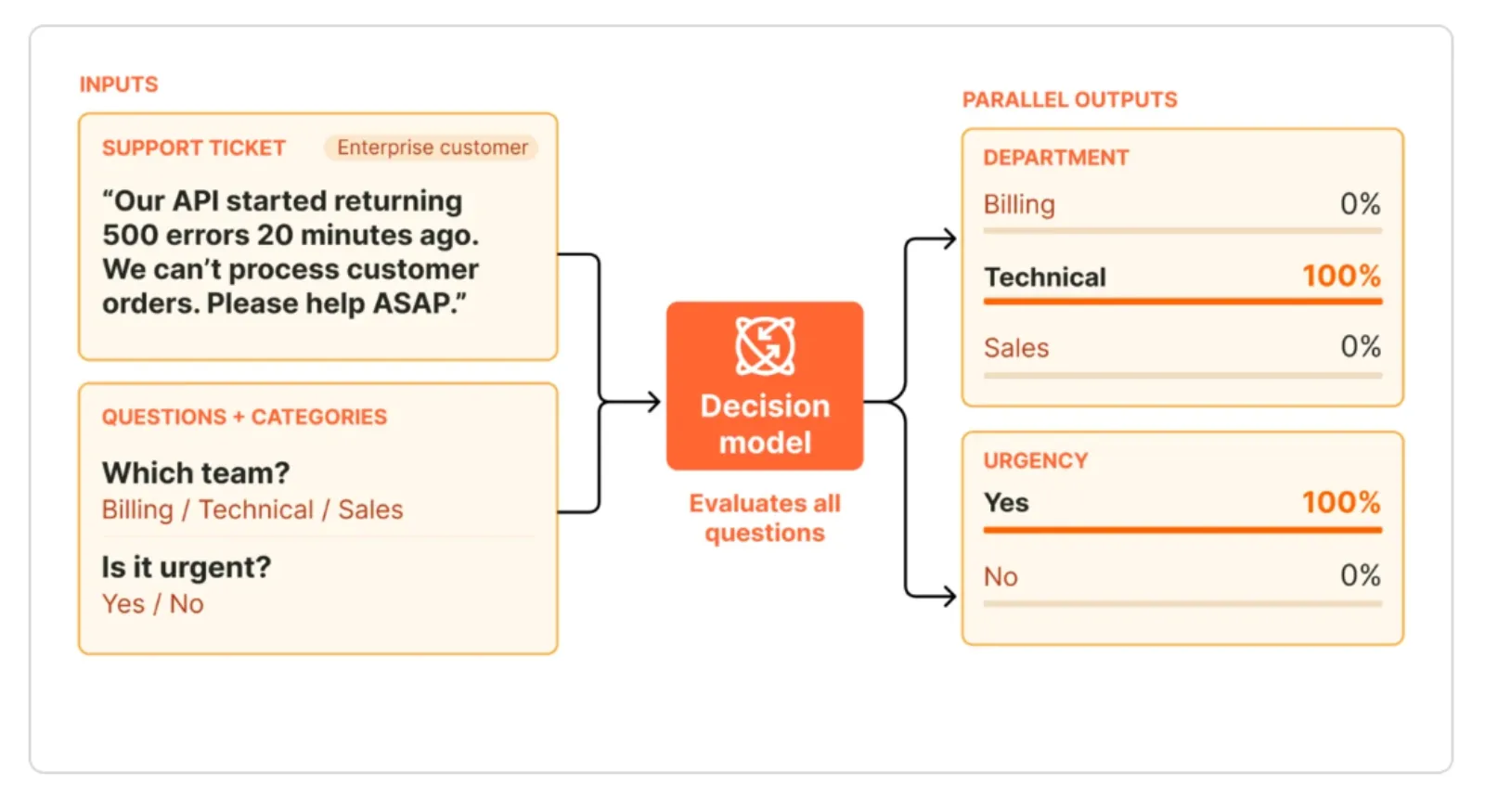
Their job is to make fast, structured decisions that a program can use immediately.
The models have appeared in Cloudflare Workers AI, and their weights were simultaneously published on Hugging Face under the Apache 2.0 license. This means Clef can be called via a cloud API or downloaded for independent experimentation.
Essentially, Cloudflare has released an open-source competitor to Jev, a model from TypeSafe AI that appeared just a few weeks ago and proposed a different approach to building AI agents. Instead of asking a large language model to write a response, a developer passes the system state and several predefined questions to the model. In return, they receive structured probabilities, which the program uses to decide what to do next.
For example, an agent receives a customer message: "I was charged twice from my account, please refund it."
A standard language model might write a long response, explaining the situation and suggesting several courses of action. A decision model works differently. You can ask it specific questions: does the request relate to billing, is human intervention required, and how urgent is the situation? The program receives values it can work with directly: for instance, an urgency probability of 97% and a billing category with 94% probability.
This significantly simplifies automation. There is no need to force an LLM to generate JSON, then validate its format, fix errors, and retry the request if the model returns something incorrect. Clef provides a limited, structured result by design.
Why did Cloudflare follow Jev's lead?
Jev was released in September 2026 and became the first public model from TypeSafe AI in a new category the company calls System One Models. TypeSafe positions it as a model for rapid decision-making within software systems. Jev does not generate free-form text; instead, it returns typed responses and probabilities.
Cloudflare has essentially decided to use the same idea.
The company explicitly calls Clef a model of the same class as Jev and has made it compatible with the System One API. Therefore, an existing integration with Jev can be switched to Clef relatively easily by changing the endpoint and the model. The API supports three main types of questions: noul for yes/no answers, choice for selecting one option, and score for evaluating against a given scale.
For developers, this means a simpler alternative to TypeSafe's closed model has emerged. But Clef has one more significant difference: it is multimodal.
Clef can work with more than just text
Most similar decision models are currently text-oriented. Clef can process text or JSON, as well as images and video. In Workers AI, you can pass up to four images per request, and the context window is 65,536 tokens.
For example, an agent could receive a screenshot of a page and determine if it belongs to a specific category. Or it could process a product image and decide if it violates marketplace rules. Or it could analyze visual context alongside text data to decide whether to escalate the situation to an operator.
For Cloudflare, this is particularly interesting for its own products. The company is already testing Clef for classifying internet domains in threat intelligence. Combined with Browser Run, the model can open a website, retrieve its content, and classify the domain. Cloudflare also uses it for support and trust & safety tasks.
Two models instead of one
Cloudflare released two versions at once.
Clef has 27 billion parameters and is primarily designed for tasks where decision accuracy is paramount. Clef-flash contains 9 billion parameters and is intended for situations where latency is critical. Both models feature a 64K token context window and utilize the same concept of structured decisions.
Cloudflare used the Qwen family as a foundation. Clef is built on Qwen3.8-27B, while Clef-flash is based on Qwen3.5-9B. The models were then fine-tuned specifically for decision-making tasks. In particular, Cloudflare used the RLCD approach—Reinforcement Learning for Calibrated Decisions—to ensure the model's probabilities better align with the actual probability of a correct answer.
Probability calibration is especially important here. For a standard chatbot, it doesn't matter much whether it provides a confident answer with a 73% or 91% probability. In an automated system, this can determine whether an action is performed autonomously or if the task is routed to a human.
Clef is noticeably faster than Jev
Cloudflare tested the models over 43 runs and compared them to Jev.
The median latency for Clef was 209.3 ms, whereas Jev's was 524.1 ms. Clef-flash showed an even lower result: 38.8 ms. According to Cloudflare, this is approximately 2.5 times faster than Jev for Clef and 13 times faster for Clef-flash.
This is particularly vital for agents.
If a decision model is called only once a day, a difference of a few hundred milliseconds is practically unnoticeable. But if an agent processes thousands or millions of requests, and at every step it must determine a route, check a permission, or decide whether to call the next tool, latency begins to directly impact the cost and speed of the entire system.
Clef outperformed Jev in several tests
Cloudflare also compared the models across ten benchmarks. In the results published by the company, Clef achieved a better result in seven of them.
For example, in BANKING77, a test for classifying banking queries, Clef achieved a 94.2 macro-F1 compared to 79.74 for Jev. In ToolRet, which evaluates tool selection, the result was 69.2 nDCG@10 against 65.28 for Jev.
However, the pattern is not the same everywhere. For instance, in CLINC150+OOS, Jev scored 89.27 against 97.43 for Clef, and in BRIGHT, Jev showed 47.52 against 45.91 for Clef. In other words, it is not a case of one model being unconditionally superior in all tasks. Results depend on the specific benchmark.
Furthermore, these are Cloudflare's own tests, so they should be viewed as comparative results published by the company rather than an independent, definitive model ranking.
Price also plays a role
On Workers AI, the cost of Clef is currently $0.24 per million input tokens, while Clef-flash costs $0.09 per million. Output tokens for this model are not a separate expense, as it does not generate a standard text response.
Cloudflare's main bet: making decision models open-source
Jev is provided as a closed API. Clef, however, can be downloaded from Hugging Face and run locally. Both versions are released under the Apache 2.0 license.
This is a fundamental difference for companies that don't want to send every request to an external API or want to manage their own infrastructure and model versions.
At the same time, Cloudflare offers the ability to run Clef via Workers AI, meaning developers don't necessarily have to manage their own infrastructure. You can use the same class of model as a server-side API and, if needed, switch to running the open weights yourself.
Additionally, Cloudflare has simultaneously launched a reinforcement learning service for fine-tuning Clef for specific tasks. For now, the company is offering this capability through its design partners program.
What does this change for AI agents?
A Large Language Model is needed for complex reasoning, text generation, planning, and human interaction. Meanwhile, a small, specialized decision model can operate at every step of an agentic pipeline where a quick choice between predefined options is required.
Instead of an architecture where "one massive LLM does everything," we are seeing the gradual emergence of a multi-model pipeline. One model thinks and generates, another classifies, a third checks for safety, and a fourth selects a tool.
Jev has demonstrated that a dedicated decision-making model can be a standalone product class. Cloudflare has now brought open weights, multimodality, and lower latency to this class.
If you are interested in AI, technology, and the future—welcome to my channel to discuss and share updates.
Translated from Russian. Original on vc.ru: Cloudflare выпустила открытый аналог Jev. Clef принимает решения за миллисекунды и умеет работать с изображениями и видео